Branding
Company Profile for Tenders in Kenya: What Evaluators Look For
How tenders are evaluated in Kenya and what evaluators look for in a company profile: experience, staff, capacity and compliance, plus a tender-ready structure.
A company profile for tenders in Kenya has a different job from the brochure you hand a walk-in client. It sits inside a bid file next to your tax compliance certificate and price schedule, and an evaluation committee reads it with a scoring sheet beside them. This guide explains what evaluators look for, how to structure a tender-ready profile so it is easy to score, and the mistakes that quietly cost suppliers marks.
How are tenders evaluated in Kenya?
Most tenders are evaluated in stages: a preliminary or mandatory compliance check, a technical evaluation, then a financial evaluation of the bids that pass. Your company profile mainly earns its keep at the technical stage, but it can also help evaluators confirm details during the preliminary check.
The exact criteria are always set out in the tender document, usually in a section called evaluation criteria or qualification requirements. A typical public tender follows this pattern:
- Preliminary (mandatory) evaluation. Pass or fail. Evaluators check that you submitted the required documents, such as registration certificates, tax compliance, signed forms and any bid security. Missing one item can disqualify an otherwise strong bid.
- Technical evaluation. Usually scored. Evaluators award marks for relevant experience, similar past projects, key staff, equipment, methodology and capacity.
- Financial evaluation. Bids that reach the pass mark are compared on price and other financial requirements.
Private companies, NGOs and development partners often use a similar structure, sometimes with a supplier prequalification stage first. Always read the specific document; the profile should follow what that buyer asks for, not a generic template.
What do tender evaluators look for in a company profile?
Evidence they can score quickly: relevant experience, similar completed work, qualified people, capacity and compliance, presented in the order the criteria list them. Evaluators often review many bids in a short time, so anything they cannot find easily may not earn marks.
Relevant experience and similar assignments
Committees usually ask for a set number of similar contracts over a recent period. List those projects clearly: client, scope, location, value (if you are allowed to share it), dates and a contact for reference. Put the most relevant work first, not the most recent.
Key staff and qualifications
For technical work, evaluators often score the people who will actually deliver the contract. Give each key person a short profile with their role, qualifications, professional registration where it applies and years of relevant experience. Full CVs normally go in the forms the tender provides.
Equipment, fleet and capacity
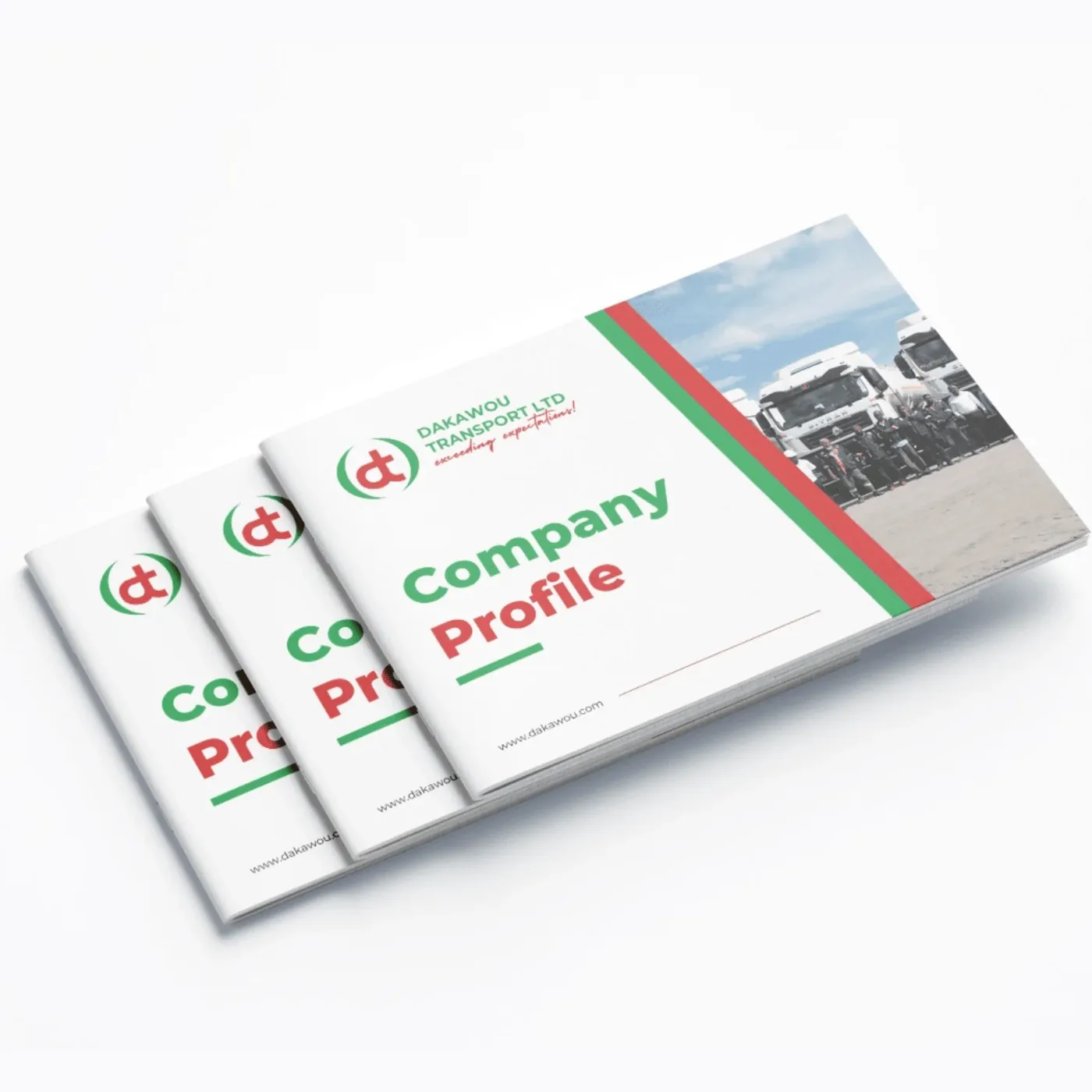
Construction, logistics and supply tenders often score capacity. Show owned or leased equipment, vehicles, premises and staff numbers in a simple table. Our work on the Dakawou Transport company profile paired fleet imagery with a clear structure for exactly this reason: buyers want to see that you can deliver.
Compliance, policies and registrations
List your registrations, licences, professional body memberships and any quality, health and safety or environmental policies you actually have. Do not claim a certification you do not hold; evaluators can and do verify.
How is a tender profile different from a normal company profile?
A tender profile is shorter on storytelling and longer on evidence, and it is arranged to match the evaluation criteria rather than your preferred sales pitch. The design should make information easy to find, not just attractive.
| Sales company profile | Company profile for tenders | |
|---|---|---|
| Reader | Prospective clients and partners | Evaluation committee with a scoring sheet |
| Order | Story, services, projects | Mirrors the tender's criteria |
| Tone | Persuasive, brand-led | Factual, specific, verifiable |
| Proof | Selected highlights | Similar projects with dates, scope and references |
| Format | Print and email | Usually PDF, sized for upload |
If you only need a one- or two-page summary for a specific buyer, a capability statement may be better. Our guide to the company profile vs capability statement explains when to use each.
How should you structure a company profile for tenders?
Follow the tender's order wherever you can, and keep a master profile you can reorder for each bid. A practical structure looks like this:
- Cover with your company name, logo and contact details.
- Company overview in a few sentences: what you do, for whom and since when.
- Legal and registration details, presented neatly in one place.
- Core services relevant to this tender, most relevant first.
- Similar completed projects, with scope, client, dates and references.
- Key personnel with roles and qualifications.
- Equipment and capacity in a table.
- Policies and compliance, such as quality, safety and environmental commitments.
- Clients you have permission to name.
- Contact details, matching every other form in the bid.
For a section-by-section template, see our company profile template and structure guide.
What mistakes cost suppliers marks?
The most common problems are out-of-date information, generic claims with no proof and details that contradict the rest of the bid. These are easy to fix before submission.
- Old content. Former directors, expired licences or projects from many years ago suggest the company is not active.
- Inconsistent details. A phone number, address or company name that differs from your registration documents raises doubts.
- Claims without evidence. "We are the leading supplier" earns nothing. A list of similar contracts does.
- Hard to navigate. No contents page, no headings and long paragraphs make evaluators work harder to find what they need.
- Files that are too large. Many buyers, including public entities using electronic procurement, require uploads in set formats and sizes. Check the limits early and prepare a compressed digital version.
- Missing permissions. Only name clients or show logos where you are allowed to.
Do special groups need anything different in their profile?
The profile itself is similar, but businesses registered under Kenya's Access to Government Procurement Opportunities (AGPO) programme should make that registration easy to see. AGPO reserves a share of public procurement for businesses owned by youth, women and persons with disabilities. Include your registration details where the tender asks for them, and check the current requirements on the official AGPO website rather than relying on old guidance.
How long does a tender-ready company profile take?
At Bravura, most company profiles take one to two days once we have complete content, and written profiles take a little longer because of the interview and drafting stages. Tender deadlines are fixed, so start well before the closing date.
Our company profile design service starts from KSh 8,500 for up to eight designed pages using content you supply, with print-ready and email-friendly PDFs and three rounds of revisions. If you need us to gather information and write the content, the Written and Designed Profile is quoted on scope, and capability statements are quoted separately. We have designed profiles for corporate clients operating across markets, as well as transport and logistics businesses.
If you bid regularly in construction or logistics, our pages on construction company branding and logistics company marketing show how profiles fit with the rest of your materials.
Getting started
Before your next bid, pull out your current profile and the evaluation criteria from a recent tender, and check whether an evaluator could find every scored item in under a minute. If not, it is time to update it.
We can restructure and design your profile around the way tenders are scored, and prepare a capability statement for specific buyers. Request a quote for company profile design and send us your current profile, even if it is rough.
Frequently asked questions
Do I need a company profile to bid for tenders in Kenya?
Many tenders ask for one, and even when they don't, a clear profile helps evaluators confirm your experience, staff and capacity. Always follow the documents listed in the specific tender.
What do tender evaluators look for in a company profile?
Relevant experience, similar completed projects with dates and references, qualified key staff, equipment and capacity, and up-to-date registrations and policies, arranged so they are easy to score.
How is a tender profile different from a normal company profile?
It is more factual and evidence-led, and it follows the order of the tender's evaluation criteria rather than a sales story.
How much does company profile design cost at Bravura?
Company profile design starts from KSh 8,500 for up to eight designed pages using your content. Written profiles and capability statements are quoted on scope.
How long does a company profile take?
Most profiles take one to two days once complete content is received. Written profiles take a little longer because of the interview and drafting stages.