Websites
.co.ke Domain for Your Website: Hosting, SSL and Email Explained
Choosing a .co.ke domain for your website? How to register it, .co.ke vs .com, hosting, SSL, business email and keeping ownership in your company's name.
Before a website can go live, it needs three things behind the scenes: a domain name, hosting and an SSL certificate. Most businesses also want professional email on the same address. Choosing a .co.ke domain for your website is a popular first step for Kenyan companies, but the terms around it often confuse people. This guide explains what each piece does, how to register a .co.ke domain, what to look for in hosting, why SSL matters and how to make sure your business, not a former developer, stays in control.
What is the difference between a domain, hosting and a website?
Your domain is your address (yourbusiness.co.ke), hosting is the server space where your website files live, and the website is the design and content people see. You need all three, and they are often bought from different providers.
A simple way to think about it:
| Piece | What it is | Comparable to | Renewed |
|---|---|---|---|
| Domain name | Your web address, such as yourbusiness.co.ke | Your plot's address | Yearly (or multi-year) |
| Hosting | Server space that stores and serves your website | The land the building stands on | Monthly or yearly |
| SSL certificate | Encryption that shows the padlock and https:// | A lock on the door | Usually automatic with good hosting |
| Website | The pages, design and content | The building itself | Built once, updated over time |
| Business email | Addresses like info@yourbusiness.co.ke | Your post office box | Monthly or yearly per mailbox |
When a website "goes down", the cause is often an expired domain or unpaid hosting.
Should a Kenyan business choose .co.ke or .com?
Choose .co.ke if your customers are mainly in Kenya, and consider .com if you sell internationally or the .com version of your name is available and short. Many businesses register both and point one to the other, so customers reach the same site whichever they type.
Reasons Kenyan businesses pick .co.ke:
- It signals a Kenyan business. Customers immediately understand where you operate.
- Availability. Short, memorable names are often still free as .co.ke when the .com is taken.
- Local relevance. Google uses many signals to understand where a business serves, and a country-code domain is one helpful hint, alongside your address, content and Google Business Profile.
The .ke namespace is managed by the Kenya Network Information Centre (KeNIC). Besides .co.ke for commercial ventures, there are other extensions for different types of organisations:
- .or.ke for not-for-profit organisations and NGOs
- .ac.ke for universities, colleges and other higher education institutions (supporting documents required)
- .sc.ke for schools at lower and middle levels (supporting documents required)
- .go.ke for government institutions (authorisation required)
- .me.ke for personal websites and portfolios
Keep the name short, easy to spell aloud and free of hyphens where possible.
How do you register a .co.ke domain?
You register a .co.ke domain through a KeNIC-accredited registrar, which is often also a hosting company. The process takes minutes once you have chosen a name.
- Search for your name on an accredited registrar's website.
- Register it in your business's name, with a company email address and phone number you control, not a staff member's personal details or your developer's.
- Pay for one or more years and turn on auto-renewal.
- Save your registrar login somewhere safe that more than one person in the business can access.
- Point the domain to your hosting by updating the nameservers or DNS records, or ask your web designer to do this for you.
A domain registered under a former employee's or developer's account becomes hard to renew or move when that person leaves, so make your business the registered owner from day one.
What should you look for in website hosting in Kenya?
Look for reliable uptime, fast loading for visitors in Kenya, free SSL, automatic backups and responsive local support. The cheapest plan is rarely the best value if your site is slow or goes offline often.
Questions to ask a hosting provider:
- Speed: where are the servers, and does the plan include caching or a content delivery network?
- Backups: how often are they taken, and can you restore one yourself?
- SSL: is a free certificate included and renewed automatically?
- Support: can you reach someone by phone, chat or WhatsApp when something breaks?
- Platform fit: does it suit the way your site is built? A WordPress site, an online shop and a custom-built site may need different setups. Our comparison of a WordPress website vs a custom website explains the difference.
An online shop or busy portal needs more robust hosting than a five-page brochure site.
Why does your website need SSL?
SSL encrypts information between your website and its visitors, shows the padlock and https:// in the browser, and avoids "Not secure" warnings that put customers off. It is essential for any site with a contact form, login or checkout.
SSL also matters for search. Google has confirmed that HTTPS is a ranking signal, although a light one, and browsers such as Chrome flag pages without it. Many hosting providers include free certificates that renew automatically. After installing SSL, make sure every old http:// address redirects to the https:// version so visitors and Google always land on the secure page. Our SEO checklist for small businesses covers this and other technical basics.
How do you set up professional email on your domain?
Create mailboxes on your domain, such as info@ or sales@yourbusiness.co.ke, through your hosting plan or a dedicated email service, then add the right DNS records so messages are delivered. A domain email looks far more credible on quotations, tenders and invoices than a free webmail address.
Two common approaches:
- Hosting email: mailboxes included with many hosting plans. Simple and low cost for small teams.
- Dedicated email services such as Google Workspace or Microsoft 365: more storage, shared calendars and strong spam filtering, billed per user.
Whichever you choose, ask for SPF, DKIM and DMARC records to be set up. These authenticate your emails and help keep them out of spam folders. Major email providers such as Gmail now expect authentication, especially from businesses sending marketing emails in volume.
Who should own and manage your domain and hosting?
Your business should own the domain and hosting accounts, even if a designer or agency manages them for you. Ownership protects you if you change suppliers.
A simple ownership checklist:
- The domain is registered in your business's name.
- You have the login details for the registrar, hosting and website admin.
- Renewal dates are in a shared calendar, with auto-renew turned on.
- Someone is responsible for updates and backups, either in-house or through a maintenance plan.
If you are planning a new site, our guide to website redesign in Kenya explains how to move to a new design without losing the search rankings tied to your current domain.
Does Bravura provide domains and hosting?
We can help. Domain and hosting are not included in our starting website packages because many clients already have them, but if you need them we recommend reliable options and quote them separately so the costs are clear.
Our website packages start with the Starter Website at KSh 26,000 for up to 5 pages and the Business Website at KSh 45,000 for up to 10 pages with a blog, Search Console and GA4 setup. Ongoing maintenance, covering updates, backups, security monitoring and small content changes, is available as an add-on. You can see indicative totals with the estimator on our pricing page, and our guide to website design costs in Kenya breaks down the full budget.
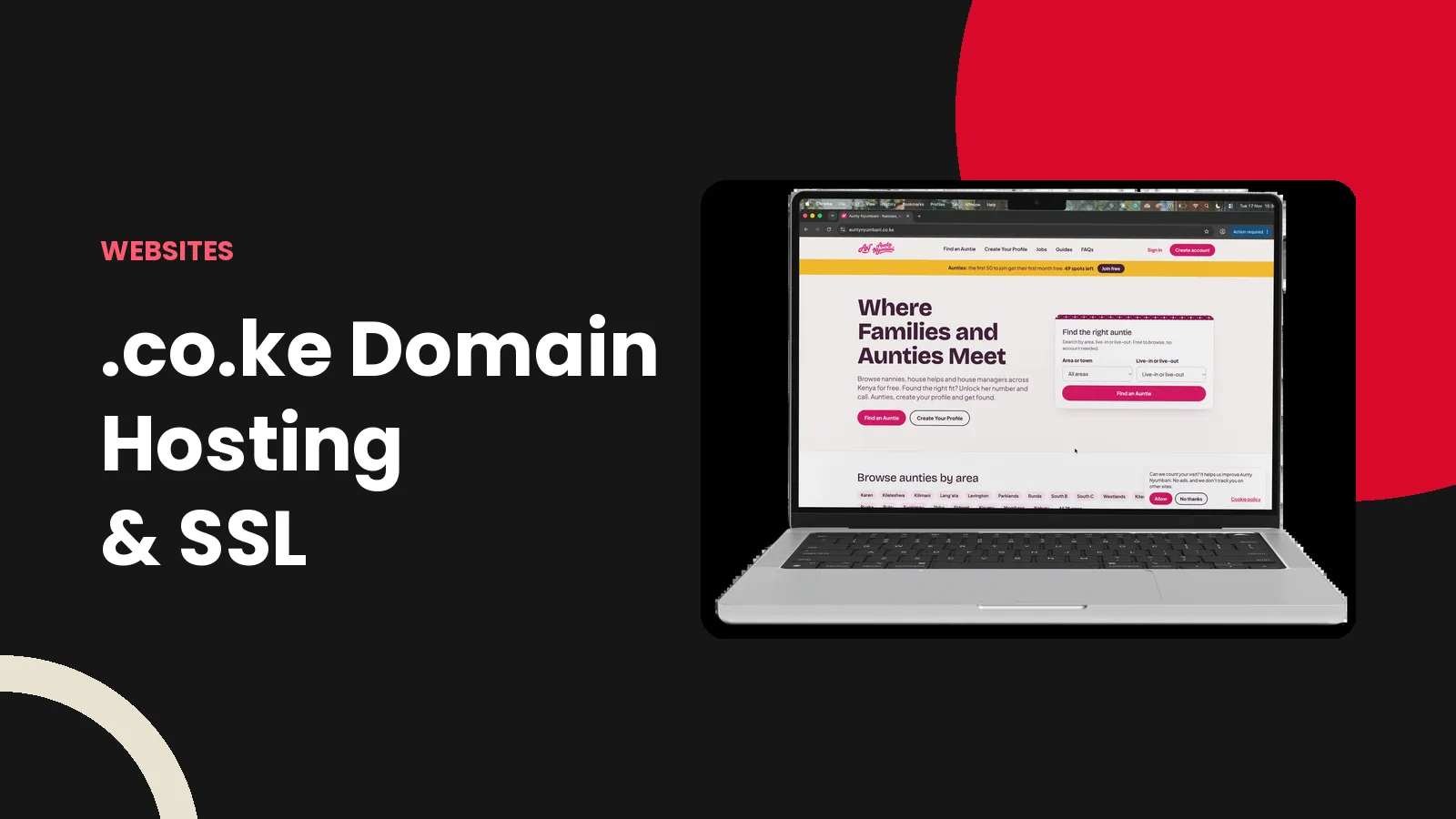
For example, when we built the brand and website for Aunty Nyumbani, the marketplace launched on its own .co.ke address, matching a brand made for Kenyan families.
Getting started
Pick a short name, check that the .co.ke (and ideally the .com) is available, and register it in your business's name today, even if the website comes later. Then choose hosting that suits the site you plan to build, with SSL and backups included.
Bravura designs and builds websites for Kenyan businesses through our website design and development service, and can recommend and quote domain, hosting and email options if you need them. Request a free quote and we'll recommend the right setup, with every cost listed before work starts.
Frequently asked questions
How do I register a .co.ke domain?
Search for your name on a KeNIC-accredited registrar's website, register it in your business's name with contact details you control, pay for one or more years and turn on auto-renewal.
Should I choose .co.ke or .com for my business?
Choose .co.ke if your customers are mainly in Kenya and .com if you sell internationally. Many businesses register both and point one to the other.
Do I need SSL on my website?
Yes. SSL encrypts data between your site and visitors, shows the padlock and https://, avoids browser 'Not secure' warnings and is a light Google ranking signal. Many hosts include free SSL.
Is domain and hosting included in Bravura's website packages?
No. Domain and hosting are not included in the starting packages because many clients already have them. If you need them, we recommend reliable options and quote them separately.
Who should own my website domain?
Your business. Register the domain and hosting in the company's name and keep the logins, even if a designer or agency manages them for you.